

1.Japan’s Prime Minister Shigeru Ishiba has announced his resignation after less than a year in the role – following two crushing election losses in mid-term elections. His resignation came a day before opponents in his Liberal Democratic Party (LDP) were expected to vote him out.
2.His departure sets the stage for yet another ruling party leadership contest in Tokyo, the third in five years. That is apart from two national elections – neither of the winners completed their term. But the country’s future leader now faces a daunting task – balancing fraught US-Japan relations, rising inflation and a cost of living crisis, and a government that has lost its majority in both houses of parliament.
Why did Ishiba resign?
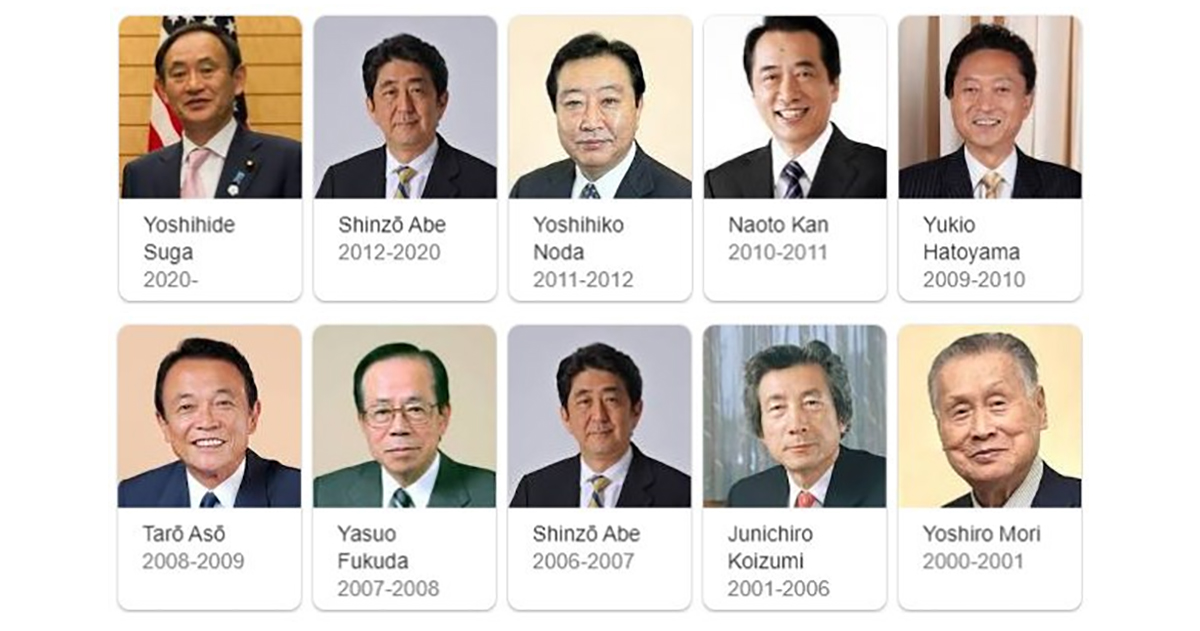
3.In 2020, Yoshihide Suga – who was previously the party’s Chief Cabinet Secretary – stepped up to the role after the surprise resignation of the late Shinzo Abe, who had stepped down due to health issues. After just a year in power, Suga resigned due to plummeting polls – and was replaced by Fumio Kishida, who then went on to win the election late in 2021.

4. But Kishida didn’t last long either – his popularity plunged in the wake of a corruption scandal involving the LDP, rising living costs and a slumping yen. And in 2024, he was replaced by Ishiba – who announced plans for a snap election just days after being elected, saying it was “important for the new administration to be judged by the people as soon as possible”.
5. And judge him they did. Many in the electorate were still furious over the corruption scandal that implicated senior members of the LDP, and were struggling to deal with rising inflation and a cost of living crisis. They delivered the LDP its worst result in over a decade and caused it to lose its single-party majority in the powerful lower house.
6. Earlier this year, the LDP suffered another defeat in the upper house parliamentary elections where it also lost its majority. Ishiba resisted calls for him to step down at first, saying he needed to take responsibility for the LDP’s losses and to deal with a trade deal with Washington.

Of all the prime ministers, who do you consider the most impressive?
7.But on Sunday – ahead of an internal leadership vote that could have forced him out – he bowed out, announcing his resignation. “Voices had been mounting from within the party that the PM must take responsibility… [and] the writing was on the wall,” said Tomohiko Taniguchi, a specially appointed professor at the University of Tsukuba and previously a special advisor to the late PM Shinzo Abe. “So rather than waiting to endure public humiliation, Ishiba chose to step down,” said Dr Taniguchi.
Who might be the country’s next leader?
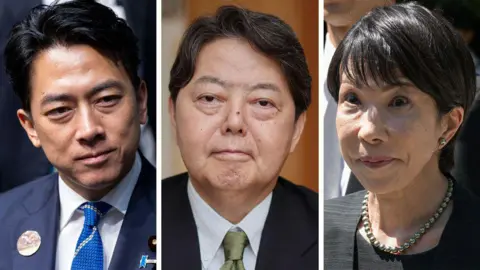
Shinjiro Koizumi, Yoshimasa Hayashi and Sanae Takaichi could be in the running for the role
8.The LDP vote is expected in early October, with the winner almost certain to become prime minister. No one has announced their intention to run, but there are three names that have emerged as possible contenders. They are: Shinjiro Koizumi, the agricultural minister and son of a popular former prime minister; Yoshimasa Hayashi, the chief cabinet secretary; and Sanae Takaichi, who would be Japan’s first female prime minister if she won.
9.All three had come up against Ishiba in the previous presidential race in 2024 – with Takaichi initially emerging as the strongest candidate in the first round of votes. However, Takaichi – a close ally to Abe – was later overtaken by Ishiba. The 64-year-old is a hardline conservative and is known to oppose same-sex marriage. Her positions on women’s issues are in line with the LDP’s policy of having women serve in traditional roles.
