1.[responsivevoice voice = “US English Female” buttontext = “”]Merriam-Webster’s Word of the Year for 2023 is authentic—the term for something we’re thinking about, writing about, aspiring to, and judging more than ever. A high-volume lookup most years, authentic saw a substantial increase in 2023, driven by stories and conversations about AI, celebrity culture, identity, and social media.[/responsivevoice]
2.[responsivevoice voice = “US English Female” buttontext = “”]Authentic has a number of meanings including “not false or imitation,” a synonym of real and actual; and also “true to one’s own personality, spirit, or character.” Although clearly a desirable quality, authentic is hard to define and subject to debate—two reasons it sends many people to the dictionary.[/responsivevoice]
3.[responsivevoice voice = “US English Female” buttontext = “”]Authentic is often connected to identity, whether national or personal: words frequently modified by authentic include cuisine and dish, but also self and voice. Celebrities like singers Lainey Wilson, Sam Smith, and especially Taylor Swift all made headlines in 2023 with statements about seeking their “authentic voice” and “authentic self.”[/responsivevoice]
4.[responsivevoice voice = “US English Female” buttontext = “”]And with the rise of artificial intelligence—and its impact on deepfake videos, actors’ contracts, academic honesty, and a vast number of other topics—the line between “real” and “fake” has become increasingly blurred.[/responsivevoice]
5.[responsivevoice voice = “US English Female” buttontext = “”]Authentic is what brands, social media influencers, and celebrities aspire to be. Elon Musk made headlines when he said that people should be more “authentic” on social media. Apps and platforms like BeReal make recording “authentic” experiences their main purpose.[/responsivevoice]
6.[responsivevoice voice = “US English Female” buttontext = “”]No matter how much artifice and calculation goes into the production of these videos, as Rebecca Jennings of Vox puts it, “wherever people are supposedly being ‘authentic’ on the internet, the money will follow.” Ironically, with “authentic content creators” now recognized as the gold standard for building trust, “authenticity” has become a performance.[/responsivevoice]
Other words also stood out in the dictionary’s 2023 data, including:
7.[responsivevoice voice = “US English Female” buttontext = “”]Rizz, an example of internet-driven slang, shot to the top of lookups when it was added to the dictionary in September. As a noun, rizz means “romantic appeal or charm” (as in “a bro who has rizz”); as a verb (typically used with up, as in “rizz up that cutie”) it means “to charm or seduce.” It’s frequently considered a play on charisma, but YouTuber Kai Cenat (shown above), widely credited with coining the word, says nah, that’s not what it’s from. No other lexical inspiration has been identified though.[/responsivevoice]
8.[responsivevoice voice = “US English Female” buttontext = “”]The quest for authenticity partly results from technologies like the deepfake: “an image or recording that has been convincingly altered and manipulated to misrepresent someone as doing or saying something that was not actually done or said.”[/responsivevoice]
Coronation
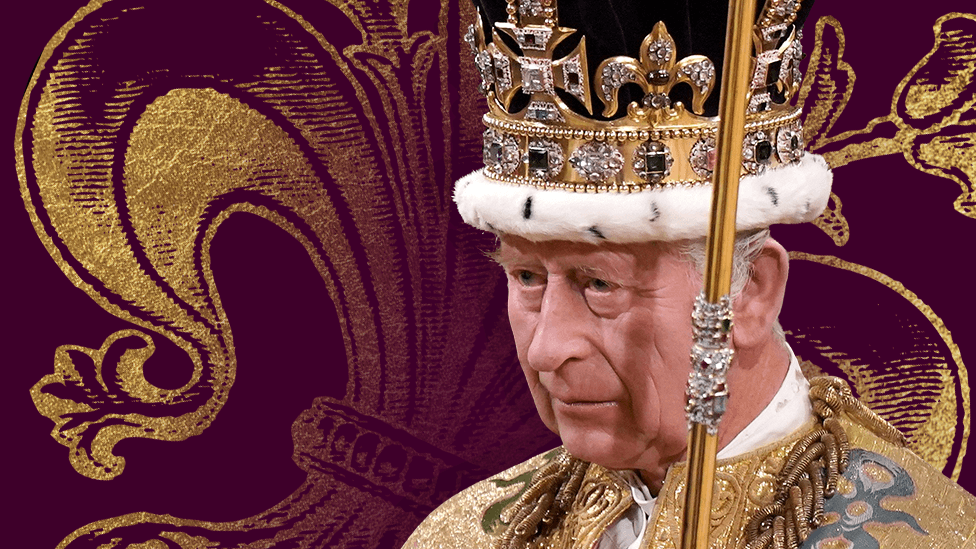
9.[responsivevoice voice = “US English Female” buttontext = “”]The ceremony to crown a new British monarch—Charles III—caused this term to spike in May. Coronation refers to the literal act of placing a crown on a monarch’s head, a synonym of crowning. It is also more figuratively used to refer to the assumption of a prominent position or office, as in “the coronation of the league’s MVP.”[/responsivevoice]